E-Drive Delivers: Real Data, Real Results, Real Performance
This is the second article in our E-Drive Performance Series following on from the first article that focused on power generation efficiency — how E-Drive transforms onboard energy.
In the first article, we showed how E-Drive significantly outperforms traditional generators. On sea trials with Balance 502 and 526 catamarans, E-Drive delivers generation efficiencies of 4.1–4.7 kWh per litre of diesel, compared to 2.8 kWh/litre for a conventional genset — a 46% to 68% efficiency improvement. Charging a 48 kWh battery bank from 20% to 80% takes roughly one hour when generating 26 kW, and fuel consumption for a full charge drops by 32–40% depending on the boat model.
In real-world cruising, this translates to fuel savings, longer range, reduced emissions, and a lower reliance on shore power — validating E-Drive’s role as a smarter, cleaner, more efficient onboard energy solution. It is this foundation of high-efficiency generation that makes powerful electric propulsion possible.
In this blog, we will explore electric drive efficiency and range, and in the next and final blog in the series, we will take a closer look at hybrid driving, where one hull is powered by the engine and the other by E-Drive, demonstrating the full potential of intelligent, integrated hybrid propulsion.
Electric Drive Performance: Baseline Boat Speed
To understand how E-Drive performs as a propulsion system, tests were performed with three different models of Balance Catamarans.
- Balance 482 — dual 30 kW E-Drive + 45 hp engines
- Balance 502 — dual 30 kW E-Drive + 45 hp engines
- Balance 526 — dual 30 kW E-Drive + 57 hp engines
The following plot shows the boat speed for each boat as the driveshaft speed is increased. The Balance 526, with larger propellers and higher-power diesel engines, predictably curves slightly above the 482 and 502. The 482 and 502 show near-identical performance, reflecting their similar hull geometry, displacement and common engine size.
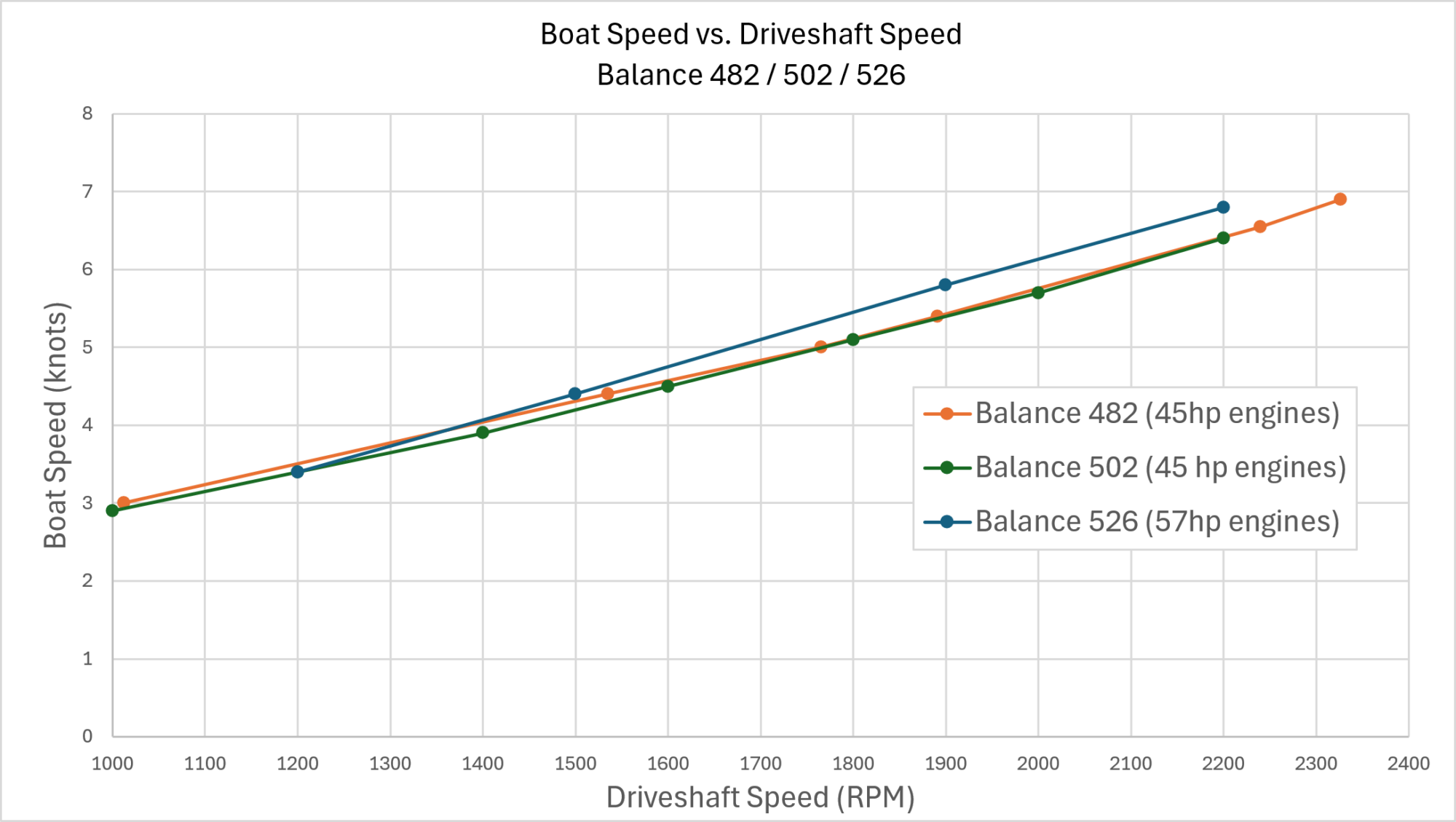
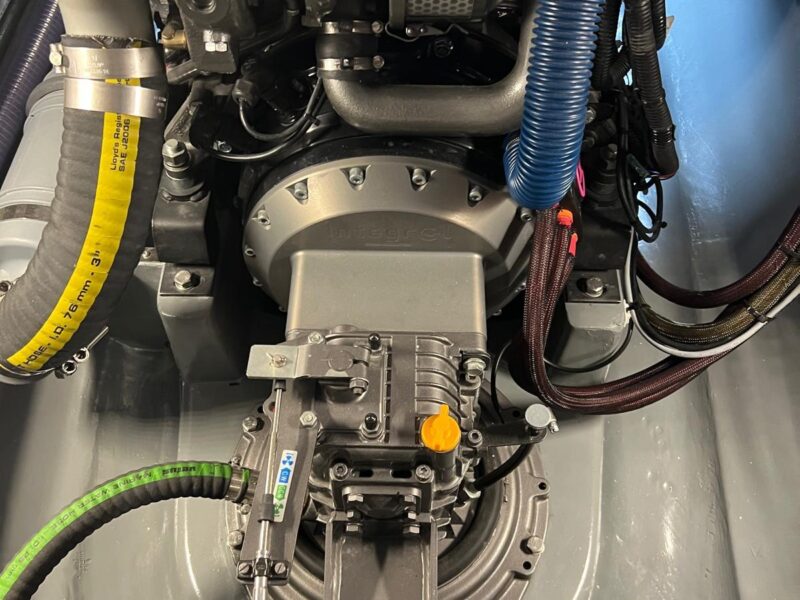
The driveshaft (and gearbox/propeller) can be driven either from the E-Drive motor in electric mode, or by the engine. Because E-Drive directly powers the driveshaft through the gearbox, electric propulsion achieves the same shaft RPM, and thus the same boat speed, as the diesel engine. This confirms a core design goal: E-Drive matches diesel-driven shaft performance while offering much finer speed control and smoother propulsion.
Range: How Far Can You Motor on E-Drive Alone?
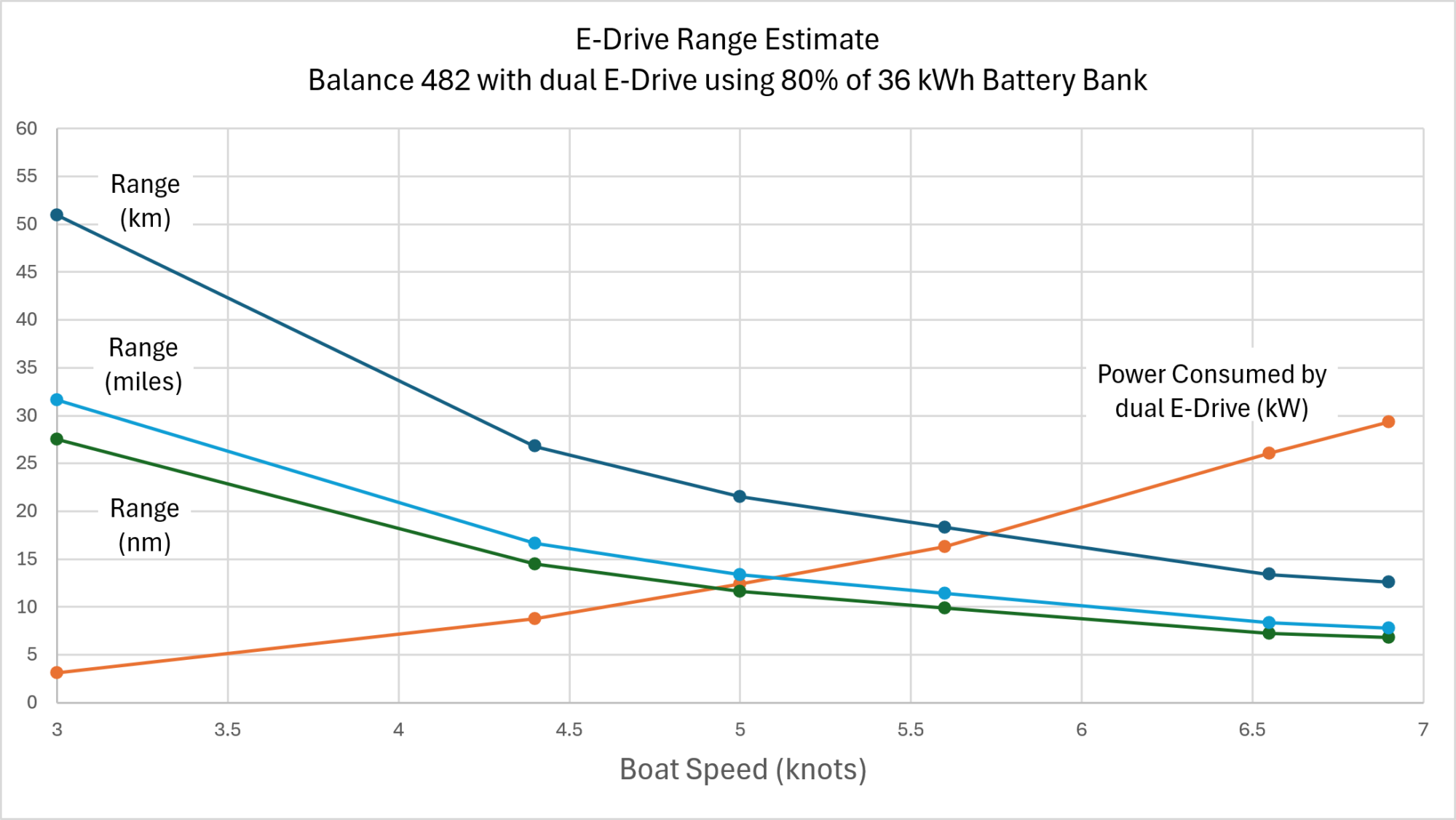
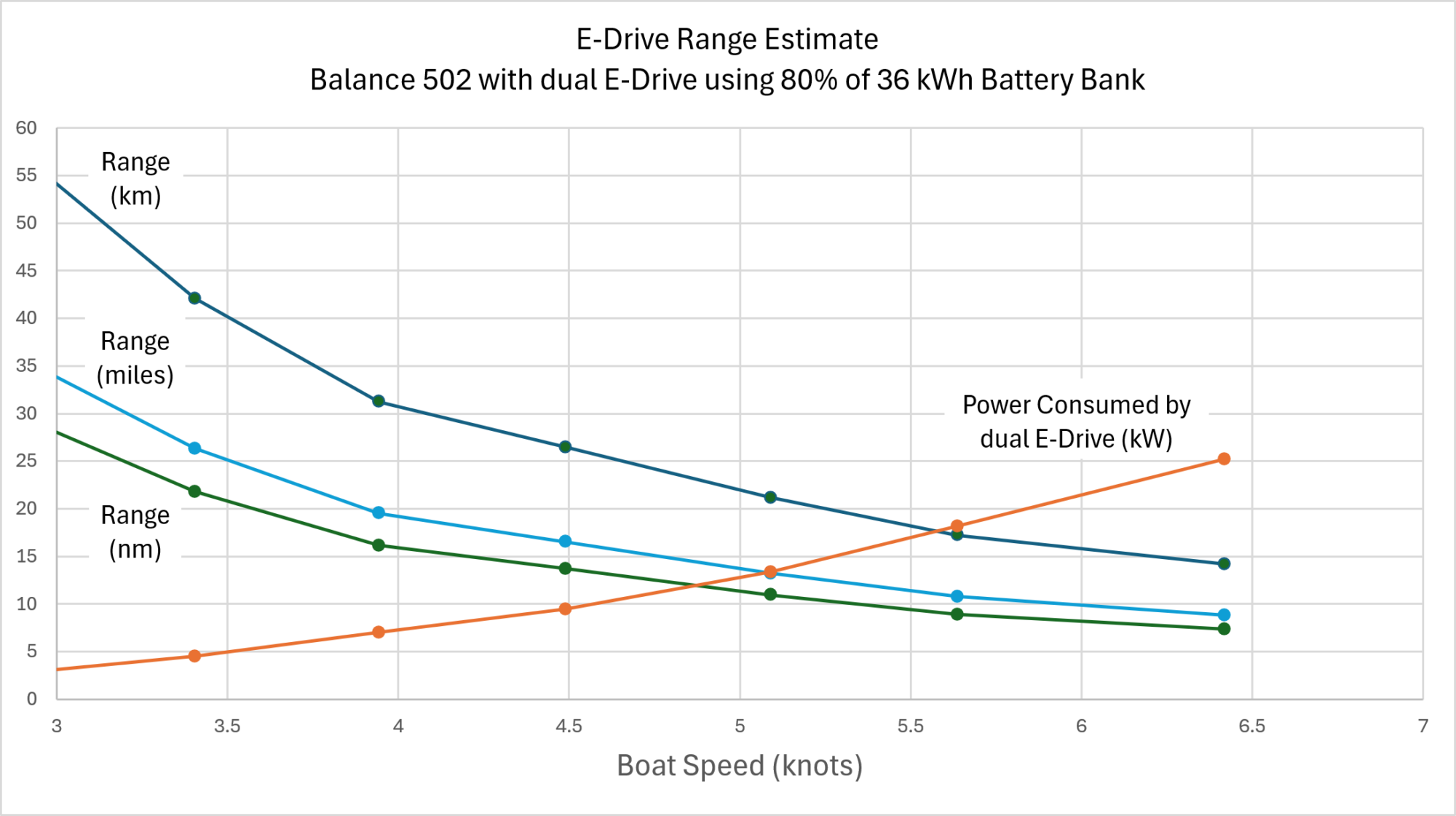
Using the Balance 482 and Balance 502 as benchmarks, we tested and modelled range with electric-only propulsion using:
- Dual 30 kW E-Drives
- 36 kWh battery bank
- 80% usable capacity (it is generally not recommended to fully discharge batteries)
Range varies significantly depending on boat speed as shown in the following plots and explained further below.
Key Takeaways
The range of the Balance 482 and Balance 502 is similar, reflecting the similarity of their fitout and construction:
- At 3 knots: Range is around 27-28 nm and Power usage is 3–4 kW
- At 5 knots: Range drops to around 12 nm as power demand increases
- At 6+ knots: Power draw climbs rapidly (18–30 kW), reducing range to 6–8 nm
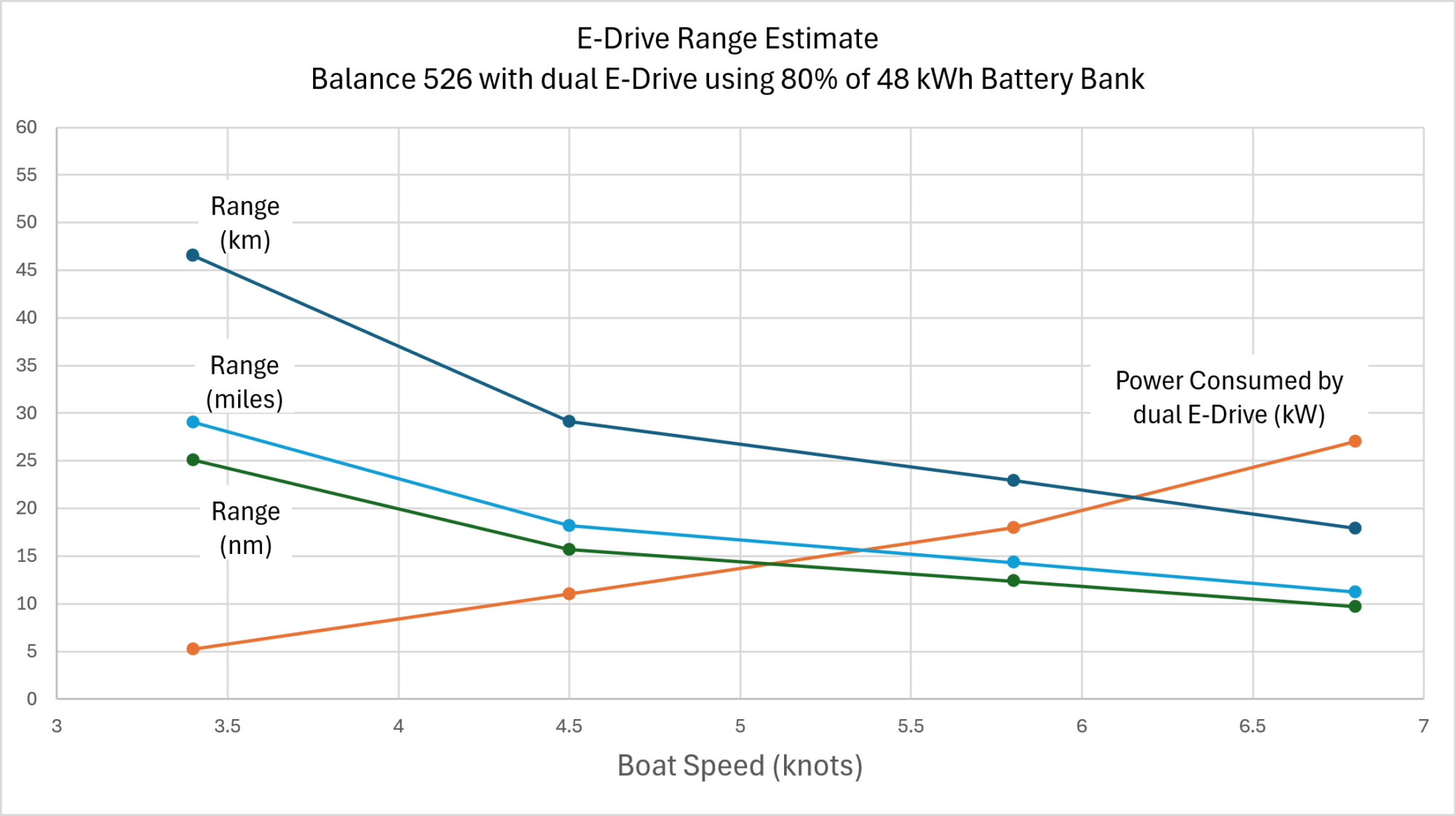
Comparing the Range of the Balance 526
Despite being larger and heavier than the Balance 482 and Balance 502, the Balance 526 has longer range due primarily to a 33% higher energy capacity battery bank. The range of the Balance 526 is a respectable 25 nm at 3.5 knots, decreasing to around 12 nm at speeds above 6 knots.
Why does Range Decline at Higher Boat Speeds?
Hydrodynamic drag increases exponentially with propeller speed, meaning small increases in speed lead to large increases in power consumption. This is true for all vessels, diesel or electric.
Where Electric Propulsion Shines
E-Drive is not designed as an alternative to long-distance diesel motoring — nor should it be. Instead, it offers high-value, high-precision propulsion for the most common and most inefficient requirements of boat handling.
1. Instant Silent Manoeuvring in a Marina
- No delays waiting while diesel engines warm up.
- Move on and off pontoons with zero noise, instant torque, and no exhaust.
- Perfect for early-morning departures, tight berths, and crowded slips.
2. Speed Boost When Sailing
- Using E-Drive to turn the propeller at low speeds/low power increases apparent wind, adding 1–2 knots of extra boat speed in marginal conditions.
- Ideal for multihulls that struggle to maintain flow over the sails in light air.
3. Assisting Tacks and Gybes in Light Wind
- Instant bursts of electric thrust help large cruising cats to complete manoeuvres cleanly.
- Particularly helpful when sailing shorthanded.
4. Ultra-Fine Speed Control
A diesel engine typically idles around 800 RPM. E-Drive can run the driveshaft as low as 250 RPM, delivering significantly better precision for:
- Anchoring
- Docking
- Picking up moorings
- Close-quarters manoeuvres
Wrapping Up
We designed E-Drive from the ground up to improve the energy efficiency, experience and convenience of using your boat, but it is not designed to suit all situations.
✔ E-Drive is designed for:
- Harbour manoeuvring
- Silent starts/finishes
- Instant assist with tacks and gybes
- Incremental speed boost when sailing
- Reduced propulsion noise in aft cabins
- Short transits
- Coastal anchorage adjustments
- Emergency redundancy
✘ E-Drive is not designed for:
- Replacing diesel engines on long passages
- Motoring for hours at >5 knots
This hybrid balance — diesel for long range, electric for efficiency, precision and convenience — is what makes the system so powerful.
Coming Next: Part 3 – Intelligent Hybrid Motoring
In our final E-Drive Performance Series, we’ll explore hybrid motoring with one diesel engine + one E-Drive. We’ll show how running a single diesel engine while powering the other shaft electrically delivers:
- Free speed gains
- Fuel reductions
- Extended battery range
- Lower engine running hours
And we’ll demonstrate the real-world data behind the owner-reported experience of: “Around 1 knot of free speed when running one diesel and one E-Drive.”
Stay tuned — the hybrid story is where E-Drive’s full potential becomes unmistakable.
Ready to choose Integrel?
Get in touch today and our friendly, experienced team can help you start living a more luxury and environmentally friendly life out on the water…